

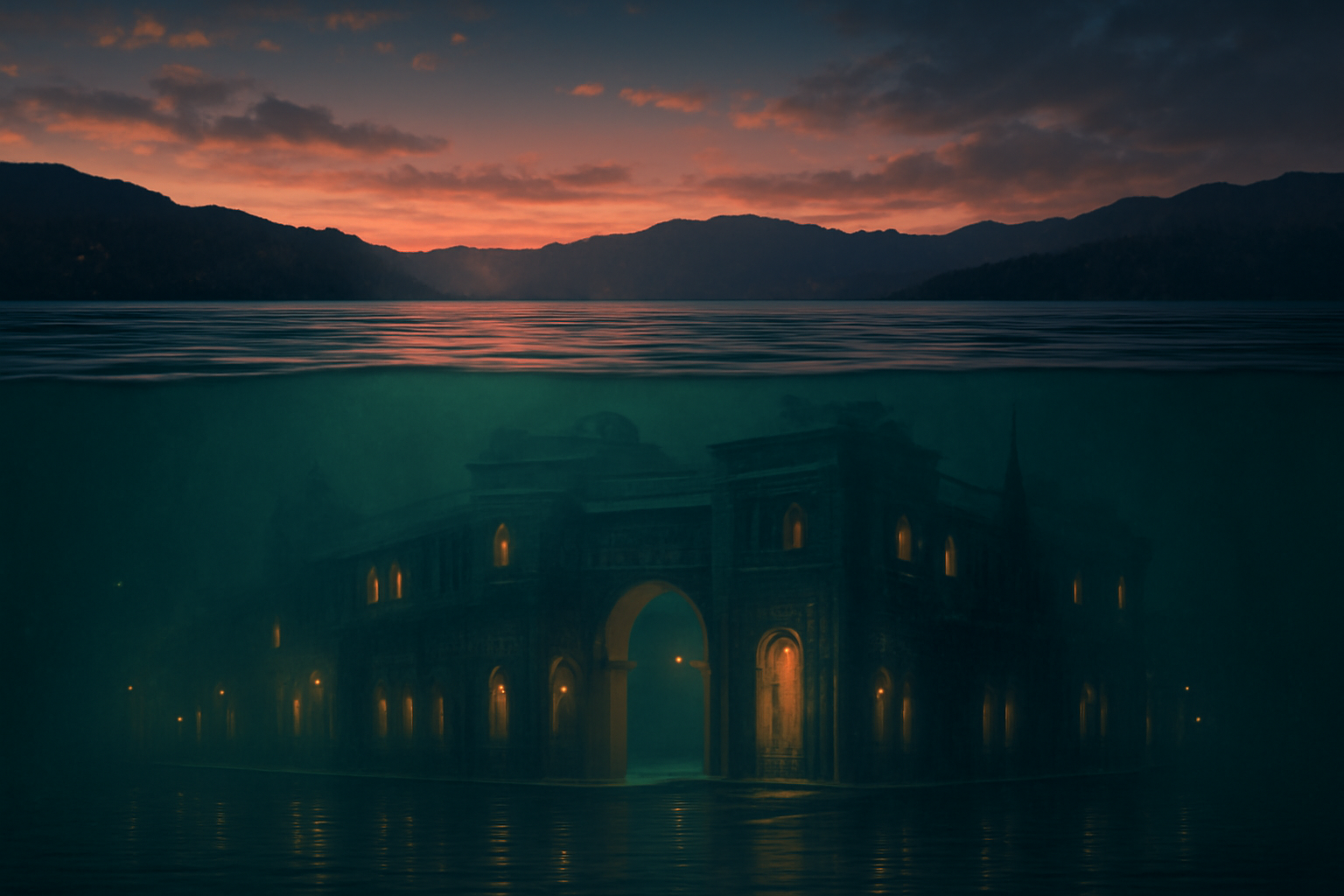
The first time the city called to her, it did it with a dream.
Not a normal dream, where faces blurred and scenes jumped and nothing quite made sense. No — this one was clear. Sharp as a reflection in still water.
In the dream, Mira stood at the edge of Lake Elessen, wind braiding through her hair. The lake was calm, so calm it looked like a sheet of dark glass laid carefully between the hills. The sky above it was twilight, streaked with rose and indigo.
“Look closer,” a voice murmured. It sounded like her own, but older.
Mira knelt and peered down.
Far beneath the water, where there should have been only murky depths, she saw streets.
Streets paved with pale stone.
Lamp posts glowing softly.
Balconies draped in flowering vines that swayed as if in a wind that couldn’t reach the surface.
A city. Silent. Sleeping.
And in one of the streets, standing beneath an archway, she saw a figure turn and look up at her.
Her heart jolted.
Because the figure had her father’s smile.
“Dad?” she whispered.
The water rippled. The city blurred.
Mira reached out — and as her fingertips touched the surface, she woke up in her small apartment, fingers outstretched toward nothing, Lake Elessen seventy miles away.
Her pillow was damp with tears she didn’t remember crying.
Her father had been gone for exactly one year.
Most people in Larkstead knew Lake Elessen as the “bottomless lake,” though the scientists on the university hill had proven that wrong decades ago. Still, the name stuck. The lake was deep, mysterious, and rumored to be older than the town itself.
There were stories, of course. Every place had them.
Stories about voices heard over the water on windless nights.
About lights moving just beneath the surface.
About dreams that felt too real.
But Mira had grown up rolling her eyes at that kind of thing.
Her father had been a historian. He loved facts and dates and carefully labeled map drawers. He told her, “Legends are just stories we haven’t properly shelved yet.” And he’d wink and show her some ancient shard of pottery instead.
Now, though, the legend was in her own head, and it wore his face.
For three nights in a row, the dream returned.
Always the lake.
Always the city beneath.
Always her father’s familiar posture, leaning against the archway as though he’d been waiting for her to show up.
On the fourth night, she spoke first.
“Where are you?” she called down.
Her father smiled — that same small, lopsided smile she’d seen a thousand times across kitchen tables and museum brochures.
“In the place we forgot,” he answered.
“What does that mean?”
He just tipped his head, as if listening to something else. “Come visit, Mira. The way is open.”
When she woke that time, she didn’t stop to think.
She packed a bag.
Lake Elessen looked exactly as it did in her dream.
Smooth. Dark. Patient.
The sun hung low when she arrived, turning the water into molten copper. The air smelled like pine and distant rain. Mira stood at the rocky shore with her backpack and a heart full of questions that didn’t fit into words.
“This is ridiculous,” she muttered, more to the memory of her father’s eyebrows than to herself. “I’m talking to a lake.”
The lake didn’t seem offended.
It just lay there, reflecting the sky.
Still, she couldn’t ignore the tug in her chest — that strange, insistent pull that had been with her since the first dream. It felt like standing on the threshold of a house you’d lived in as a child but couldn’t remember leaving.
She walked the shoreline, boots crunching over pebbles, until she found the old stone pier.
Her father had brought her here once, when she was ten, pointing out little things with scholarly excitement — the way the stones didn’t match the town’s usual style, the faint carvings worn almost smooth by time.
“These are older,” he said. “From a city that probably sank centuries ago. If we listen, places like this tell us stories about who we were.”
“Will the city ever come back?” she’d asked.
“Maybe not above water,” he’d replied. “But in other ways? In memory? In dreams? Cities don’t really die, Mira. They just change shape.”
She thought of that now as she stepped onto the ancient stones, their surfaces cool beneath the late-afternoon sun.
At the end of the pier, she looked down.
For a long moment, all she saw was herself — a young woman with wind-tousled hair, grief in her shoulders, and a determination she didn’t quite understand.
Then the water trembled.
Just slightly.
As if something had knocked gently from underneath.
Light rippled.
The reflection of the sky fractured — and beneath it, faint but unmistakable, she saw the outline of a street.
Her breath caught.
The city was there.
Exactly as in the dream.
Lampposts. Balconies. Pale stone.
And at the nearest corner, under the curve of an archway, stood her father.
He waved.
Entirely forgetting that this wasn’t how the world worked, Mira waved back.
“Is this real?” she called. Her voice shook.
“Real enough,” he answered. Somehow, incredibly, she heard him as clearly as if he were standing beside her. The lake’s surface barely moved. “Real in the ways that matter.”
“I miss you,” she blurted.
“I know.” His smile softened. “Come walk with me.”
She stared at the water. “I can’t exactly breathe down there.”
“You won’t need to,” he said. “This place remembers more than stone and water. It remembers us.”
Before fear could catch up, the tug in her chest deepened, like a thread being gently pulled.
Mira inhaled.
Then stepped off the edge of the pier.
She braced for impact.
For cold, choking water.
For the heavy grip of the lake pulling her down.
Instead, she felt… nothing at all.
No splash. No sinking.
Just a strange lightness, as if she were stepping through a curtain of cool air. For a heartbeat, everything went dim.
Then she was standing on solid ground.
Dry.
Breathing.
The city rose around her in quiet, luminous detail.
The sky above was not the sky she’d left. It glowed with a soft, pearly light, as if it were perpetually just before dawn. The air smelled like rain and old books. The stones underfoot were smooth and warm, their edges softened by time.
“Welcome to Arelion,” her father said.
She spun.
He was there.
Her father. In the same sweater he’d been wearing the day he’d collapsed in his office, the day her world had cracked in half. His eyes, the same hazel she’d inherited, were bright and alive.
She didn’t think. She just ran to him.
He caught her in his arms with a soft “oof,” laughing, the sound muffled by her sobs.
For a long while, all she did was hold on. Feel the solid weight of him. Smell the faint hint of tea and ink that always clung to his clothes.
“I don’t understand,” she whispered into his shoulder. “Am I dead? Are you…?”
He pulled back gently, hands on her shoulders.
“Not dead,” he said. “Not in the way you’re thinking.”
“Then what is this? Where are we?”
He gestured around them.
“Arelion. The city beneath the lake. The city that remembers.”
“Remembers what?”
“People,” he said simply. “Moments. Lives. Everything that matters, after the world has moved on and forgotten.”
She looked around.
There were other figures on the streets — people walking, talking quietly, sitting on steps, reading in doorways, leaning out of windows. They all had a sort of luminous gentleness about them, like candlelight seen through glass.
“Are they… ghosts?” she whispered.
Her father shook his head. “Not exactly. Think of them as echoes made whole. The lake is old, Mira. It’s watched generations live and love and lose. When the city sank, it didn’t vanish. It sank into memory. Arelion is what happens when memory takes shape.”
She frowned. “Why am I here?”
“Because you kept remembering,” he said softly. “Grief pulled you open. And the city heard.”
They walked.
Mira noticed details as they moved through the streets — a mural of constellations on a curved wall, doorways carved with symbols that glowed faintly when she passed. Children laughed in a nearby square, their games unfamiliar yet strangely timeless.
“You’re taking this well,” her father remarked.
“I’m not sure I am,” she admitted. “I think I’m going to freak out later.”
He chuckled. “That’s fair.”
They passed a fountain trickling with water that reflected not their faces, but scenes — flashes of people’s lives. First kisses. Quiet apologies. Farewells. Each image lingered for a heartbeat, then dissolved into ripples.
“It shows the memories people bring here,” he explained. “All the little things they thought were lost.”
Mira watched as a woman approached the fountain and dipped her fingers into a scene of a hospital room, where an old man held her hand and smiled weakly. The woman in Arelion smiled back, eyes shining.
“It’s beautiful,” Mira said, voice thick.
“It is,” he agreed. “That’s why I wanted you to see it.”
She turned to him. “You brought me here.”
“I nudged,” he said. “Your heart did the rest.”
“Why?”
He gave her a long, searching look.
“Because you were stuck,” he said gently. “You were holding on so tightly to the pain of losing me that you forgot to remember the joy, too.”
She opened her mouth to protest.
Then closed it.
Because he was right.
Her days since his death had been filled with grayness, with lists, with the mechanical process of continuing. She’d visited his office once, then never again. His notebooks sat in a box at the top of her closet, unopened.
“I thought moving on meant forgetting,” she whispered.
“No,” he said firmly. “Moving on means carrying differently.”
They stopped at a small terrace overlooking a wider plaza. Below them, people sat at tables, sharing stories. Laughter spilled upward, gentle and free.
“Arelion exists,” her father continued, “because nothing is truly gone as long as it is remembered with love. The lake holds these memories, shapes them into streets and fountains and voices. When someone like you — someone who can’t let go — stands at its edge, it offers… a visit.”
“How long can I stay?” she asked, fear pricking her now.
“As long as you need,” he said. “But not forever.”
She looked at him sharply.
“Forever would mean you stop living your own story,” he said. “And, forgive me, but I did not raise you to spend your life in a memory, even a beautiful one.”
Tears blurred her vision.
“I don’t know how to go back without you,” she whispered.
Her father reached into his pocket and pulled out something small and smooth.
A pebble.
No — a piece of pale stone, carved into the shape of a tiny doorway.
“This is for you,” he said.
She took it. It was warm to the touch, humming faintly in her palm.
“What is it?”
“A key,” he said. “Arelion’s way of saying you’re always welcome to visit. When grief feels too heavy. When joy feels too sharp. When you need to remember that love doesn’t vanish.”
Her fingers curled around it.
“But when you stand at the lake again,” he added, “remember this city is not here to trap you in the past. It exists to remind you of how much you’ve known, and how much you can still become.”
Mira looked at him.
“Will I see you again?” she asked.
He smiled, that same lopsided, familiar smile.
“Of course,” he said. “Every time you tell a story about me. Every time you open my old notes. Every time you cook that terrible stew we both pretended to like.”
She laughed through her tears. “It was awful.”
“Truly,” he agreed.
He cupped her cheek.
“And if you come back here,” he whispered, “I’ll meet you at the pier. But I’d like it even more if, when you do, you have new stories to share.”
New stories.
Ones that didn’t end with him.
She nodded slowly.
“I’ll try,” she said.
“I know,” he replied. “You always do.”
When Mira stepped back through the city gate, the world folded.
Light. Water. Air.
She found herself standing once more at the edge of the stone pier, the lake rippling gently. The sun had barely shifted in the sky. Her clothes were dry. In her palm, the tiny stone doorway rested cool and solid.
For a moment, grief rose — wild, raw.
Then, beneath it, something else stirred.
Gratitude.
The lake lay quiet, reflecting the sky. But now, when she looked at its surface, she didn’t see just water. She saw streets. Lamps. The curve of an archway where someone she loved might be leaning, waiting to hear what happened next in her story.
She slipped the stone into her pocket.
“Okay,” she whispered to the wind. “I’ll live. And I’ll come back with better tales.”
The breeze off the water brushed her cheek like a kiss.
As Mira walked back toward town, the weight in her chest hadn’t vanished.
But it had changed.
Less like an anchor.
More like a compass.
Pointing her forward.
And somewhere deep beneath the lake, the city of Arelion glowed a little brighter, warmed by the knowledge that it had helped another heart remember:
Some worlds aren’t lost at all.
They’re simply waiting to be visited
when we need them most.